Martin Parr – RESEARCH – Enigma of Time

Martin Parr is a British documentary photographer, born in 1952 and based in Bristol/London, UK. He is most well known for his photographic projects that take an intimate and satirical look at the aspects of modern life. In particular he documents the social classes of England, drawing on stereotypes and society’s expectations. His work shows us how we live, how we present ourselves to others, and what we value in life; whether it be the food we eat, the clothes we wear, the things we buy or our leisure activities. His images show us the familiar in a way that we haven’t seen it before; it may be labelled as exaggerated or even grotesque, due to his unusual perspectives and strange motifs. His major projects include rural communities (1975–82), The Last Resort (1983–85), The Cost of Living (1987–89), Small World (1987–94) and Common Sense (1995–99).

The Last Resort was Parr’s first project that showed his work moving towards his now distinct personal style: it featured bright colours and vivid images, capturing the holidaymakers and tourists of New Brighton, which set alight his passion for observing society. The series has since become a modern classic. In contrast, Common Sense was a global project, and developed his technique further and gained him more recognition as a satirical photojournalist. The aim of the project was to highlight the idiosyncrasies of different contemporary cultures, such as a British cup of tea, a dazzling Hollywood smile and other similar cultural clichés.


“With photography, I like to create fiction out of reality. I try and do this by taking society’s natural prejudice and giving this a twist”

– Martin Parr


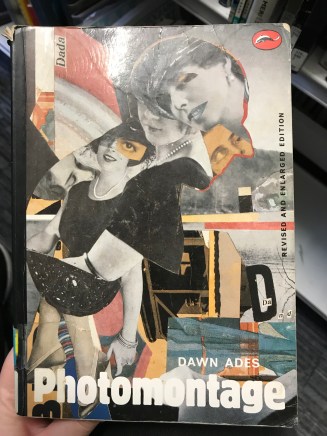
Photomontage by Dawn Ades – RESEARCH – Constructed Image

IMG_2260

While browsing the university library for books relating to my essay, I came across this book, “Photomontage” by Dawn Ades, and thought it would be a great idea to browse the pages to look for inspiration for the Constructed Image assignment. I have found this assignment the most difficult out of the three; although I appreciate a broad brief because it allows lots of creative freedom, it can prove tricky to choose which of your ideas will be the most successful and what subjects are most suitable to use, and therefore which ideas to take forward and pursue.

Photomontage and Collage are two of the processes that we can try for this assignment, and I like the idea of incorporating more than one photo into an image to create weird and wacky artwork, such as the work created by the Surrealists. A combination of images in this way can create something unreal and “fantasy” like, because people, places and objects can all be pictured together that maybe would never usually be pictured together in a single, unaltered frame taken in the present moment, or the “real world.” These techniques are totally different to the ones we learned and used last semester, and so I’m excited to try something new and expand my range of photographic processes.


IMG_2259

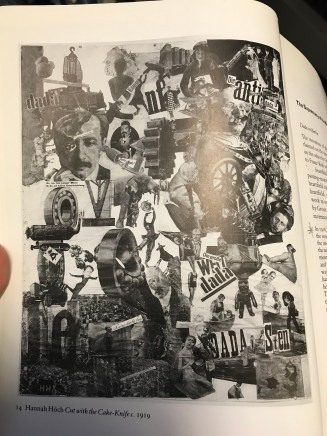
Hannah Höch, Cut with the Cake-Knife (c.1919).

Hannah Höch was a Dada artist, best known for her political collages and photomontages. Her compositions share a similarly dynamic and layered style to the works of her inspirations: Pablo Picasso and fellow Dada artist, Kurt Schwitters. Höch used her work to critique the failings of the Weimar German Government, by rearranging images and text from the mass media into collages. She preferred to be more metaphoric with her imagery, rather than taking a direct approach using text and confrontation, such as the work of John Heartfield. When the above piece was created, there was political chaos in Germany after the lost WWI. There was a struggle between two political parties; German society was navigating its way out of the old Weimer Republic and into the left-wing Communist movement. The artists within the Dada movement used photomontage to express messages of critique that would not be allowed to be put into words because of censorship. Pieces of machine can be seen exploding throughout the montage, symbolising the booming industry and culture within urban areas. This process is portrayed in a circus-like environment, rather than in a proud and sophisticated manner; the theatrical expressions and body language, mixed in with images of political figures, are used to critique the two political parties.


IMG_2262

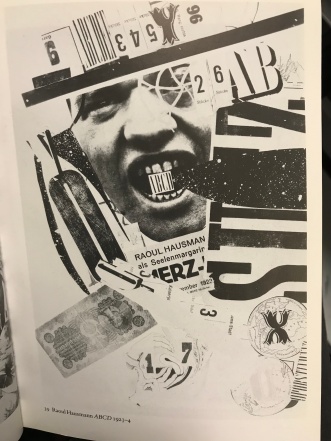
Raoul Hausmann, ABCD (1923-4).

Hausmann was an Austrian artist, best known for his satirical photomontages and his provocative writing on art. He was the founder and central figure of the Dada movement in Berlin. He met Hannah Höch in 1915 and they established a romantic affair and artistic partnership that lasted until 1922. He was involved in Expressionism until 1917, when he was introduced to the principles and philosophy of Dada; these artists created works that could question capitalism and conformity, as they believed this was the motivation for the war that had just ended, leaving behind chaos and destruction. Similar to Höch, Hausmann created collages by superimposing photos and text together that he found in newspapers, magazines, etc. In fact, it is believed that Hausmann and Höch discovered photomontage while they were on vacation on the Baltic Sea in 1918. ABCD was the final photomontage he produced, before he turned to more-traditional media. In the image, his face appears in the centre with the letters ABCD clenched in his teeth, in reference to a Dada poem. An announcement for one of his poetry performances is also collaged right below his chin. You can also see the word “voce” to the left side of his face; this translates to “voice” and represents the voice of the people wanting a revolution.


IMG_2263

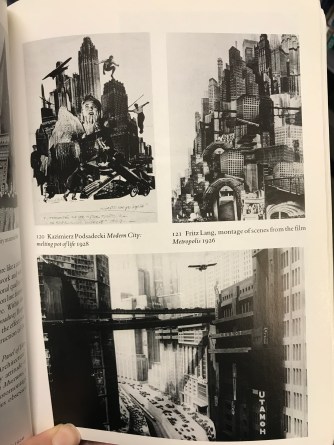
Top left: Kazimierz Podsadecki, Modern City: Melting Pot of Life (1928).

Podsadecki was a Polish painter and creator of Constructivist art. He was also interested in photomontage and experimental films. His early works were photos of compositions that he had made from various objects, and these may have been influenced by the concepts of Man Ray and Marcel Duchamp. He quoted important modernist photographs and films within his work, which was unique within European modernist art of the time. Modern City: Melting Pot of Life is themed around life in a metropolis and participation in a modern technical civilisation. It is an example of Catastrophism, which was a popular trend in the culture of the 1920s and 1930s; the trend mentioned not only the previously mentioned civilisational progress and technological development, but perhaps most importantly the subject of war, which was often depicted by an apocalyptic vision of the future. The image is dominated by solid modern tower blocks which are pieced together to create a compact mass, which represents the way that architecture is dominating and unstable and is overwhelming the world and its inhabitants.

As soon as I saw this image, it reminded me of the skyscrapers and tower blocks that I saw and photographed on the university trip to New York in February. This has given me the idea to create a constructed image, such as a collage, featuring some of these buildings somewhere. My initial thought is a teacup and saucer with the landmark buildings stood up inside, like a little city within the cup. I will work on this and experiment with layers and masks on Photoshop.

Ageing Flowers – VISUAL DEVELOPMENT – Enigma of Time

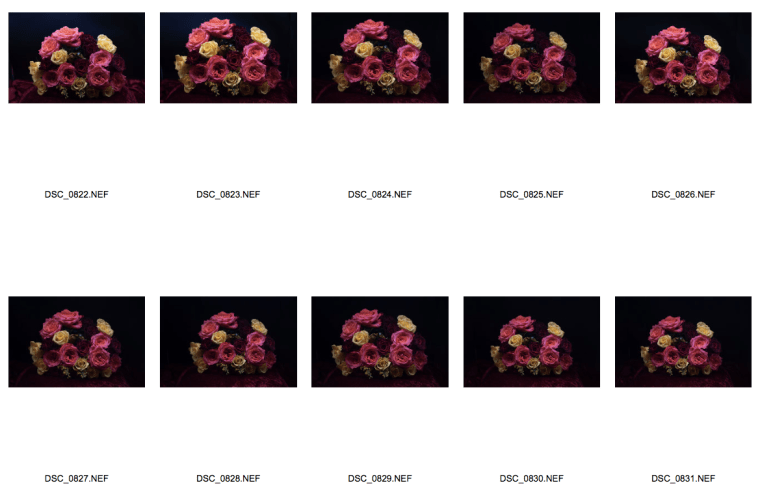
After realising that the bouquet of roses I bought were rather cliche for the Objects of Desire assignment, I decided to use what I already had and try out an idea for another assignment: photographing the same flowers in the same position as they aged, and placing the new and old images side by side to show the ageing process and how time affects everyone and everything in the world, slowly decaying nature. This could be described as “enigmatic” because it is mysterious and interesting how time affects everything differently and at different rates; the lifespan for flowers, for example, is a lot shorter than the average human lifespan, and time affects flowers and nature at a much more rapid rate.

I chose the photo from the previous shoot that had the most impact on my peers to replicate for this experiment. Using my home studio with the same background roll and the same red velvet material from the previous shoot, I did my best to replicate the entire set-up as closely as possible and place the flowers in exactly the same way, photographing from similar angles. I opened the original image in Lightroom to view the metadata to set the shutter speed, ISO and aperture on my camera to the same settings as the last one, to get the closest possible exposure. It was hard to remember the positioning of the lighting the first time around, but I experimented with it until I got a similar result. Of course it was hard to get everything exactly identical, but I’m happy with my efforts. Due to the nature of trying to recreate one particular image, there isn’t as much noticeable variety between images as they needed to be shot from the same angle and same composition; the differences are more subtle such as tiny lighting and angle adjustments.

At this point, the flowers were around 10 days old and had opened up beautifully into large roses with soft petals. One particular yellow rose near the middle of the bouquet had begun to turn brown; this was when I decided I would allow the flowers to continue to grow for a bit longer, with the hope that more of the petals would turn brown as they aged and demonstrate the ageing process even clearer.

Screen Shot 2019-04-06 at 16.57.55


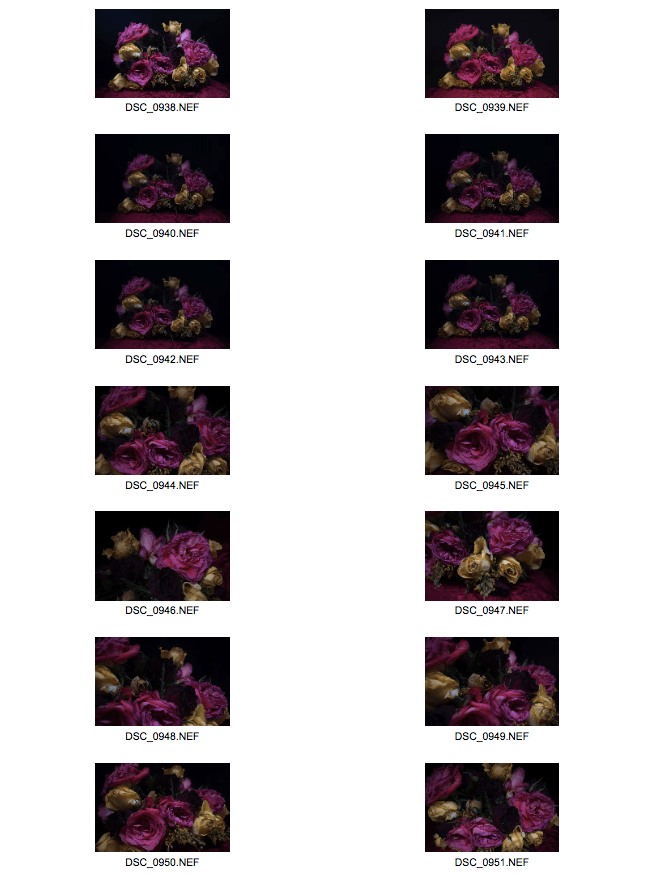
Further development (20/03/19) – I gave the flowers another week to continue the ageing process; although the petals didn’t turn as brown as I had hoped, the flowers were evidently past their best and were wilting and losing their shape and colour, meaning the element of time is still clear in the images. These images were again shot in the same environment with the same exposure, as closely to the previous two shoots as possible. I also took a few close-ups shots to see more clearly how the flowers had aged and changed. I think if I was to use these for my final submission, the comparison between the first and last image would have the greatest impact and show the largest time frame. Perhaps the middle shoot isn’t as relevant as it makes the ageing process look slower, more gradual and less effective, whereas the beginning and end give a bigger impact when comparing side by side as there is a more drastic change.

Screen Shot 2019-04-06 at 17.09.42

Valentine’s Day – VISUAL DEVELOPMENT – Objects of Desire

The first idea I began to experiment with for Objects of Desire was photographing flowers. I enjoy receiving flowers as a token of appreciation; it is a small gesture that is greatly appreciated by many. It could be said that many women in particular enjoy receiving flowers and they are a popular gift for the special women in people’s lives, often sold and advertised around special occasions such as Valentine’s Day and Mother’s Day. Of course this is a stereotype and flowers can be purchased by or as a gift for anyone, for any occasion.

03/03/19 – First, I made a trip to the local supermarket to purchase a large, beautiful bouquet of roses. Although cliche, I was drawn to the romantic and desirable nature of roses, but wanted more than just the standard bouquet of red roses, and therefore bought a mixture of yellow, orange and red flowers with additional foliage. When I got home, I placed the roses in a clear glass vase, so not to distract from the main subject. I wanted to see how the images would look if I kept the flowers in their additional wrapping, as I think flowers often look their best when they are fastened together in a tight, organised bouquet, and this is why they are sold and displayed this way, to evoke desire from customers. Although this gave a sense of order, it also gave the flowers that “freshly bought from the shop” feel, which may indicate a rushed and unplanned photo opportunity, and the paper also covered up much of the subject which wasn’t ideal.

After photographing from a variety of angles, I had the idea to incorporate other items into the shoot that were similarly romantic and desirable objects, such as chocolates and teddy bears. Both of these items are frequently sold within stores to advertise Valentine’s Day, and having personally been in a relationship for the past 6 years, I have received many of these gifts in the past, and so I added these items as a personal touch to the photographs, and to add a sense of “me” within the images. Other props I had ordered specifically to incorporate into this set of images were two pieces of fabric with a velvet look/feel, in the colours red and gold; this material and the chosen colours are often associated with desire, lust, romance and wealth, therefore this seemed like a perfectly fitting background for the main subjects, to carry the theme throughout and keep the images consistent. I realised that I could lay this material over a cushion, which would act as a base/platform for the flowers to sit on and allow me to get a straight on view of the flowers themselves, without anything obstructing them. I continued to experiment with the lighting within my photography studio/tent throughout the entire shoot, altering the angles of the light and subjects to gain the most successful results; this included the dilemma of trying to get the background as black as possible, while keeping sufficient lighting on the flowers themselves. I photographed the subjects from different angles, varying lighting and composition until I was happy with the results I had.

The contact sheets are below:

And the contact sheet of the most successful, edited images:

After presenting the images to my peers during a tutorial, I received feedback saying that the teddy bears in my shoot gave a juvenile and childish feel to the images, therefore I decided to steer clear of this subject to avoid unnecessary associations from my images. I was also advised that the subject was quite cliche and that I should seek a more creative approach to the assignment. Although this was only ever intended as a starting point, I will take this feedback on board and build from this. One of the more successful comments I received said that one of my images, “DSC_0728.jpg” would stick in the person’s mind for days because it was beautiful, in focus and detailed, and romantic with the red velvet base. Therefore I would like to experiment and see if I can still use or further improve this image somehow.


Further development and re-shoot: 12/03/19 – Responding to feedback, I initially wanted to try using a similar romantic theme to portray “the desirable” and so I experimented with other subjects, such as my mum’s necklace gifted by my brother and I, to show love through family relationships; and my Pandora bracelet and charms, each one gifted to me with love and with a personal reason behind them all. I continued using the red velvet fabric to continue the theme, as this seemed well received by my peers and tutor alike when presenting. I used my Macro lens for the first time to try and get some close-up detailed shots of the necklace, however the results weren’t quite as sharp as I would’ve liked, and I think this partly was due to my underestimation of how important a tripod would be to keep the camera completely still when pressing the shutter, and also slight trouble with focusing. I also liked the contrast between the gold, red and silver tones of the necklace with the black PVC background roll in my studio; black can also resemble elegance and sophistication, both words associated with jewellery. Similarly, the white background offers a clear contrast between background and subject to fully show off the details and colours of the subject.

While doing this, I also thought back to my previous research about Wilson Hennessy who specialises in still life photography, and took the chance to experiment with commercial photography in the studio. I found a brand new pair of trainers; Nike to be exact, a very popular and worldwide brand that many people, especially the youth of today, like to consume and purchase as expensive brands give the illusion of “relevancy and importance.” I tried to recreate, as well as create my own, compositions and poses for the subject to showcase the best angles and evoke desire from the viewer. Using the black background ensured a consistent, monochrome colour scheme that creates harmony within the image. I really enjoyed my attempt at still life photography and would like to experiment further with this approach for the assignment.

The Photographer’s Eye: Lecture Notes

This module is focused on the book titled The Photographer’s Eye by John Surkowski. The book outlines the 5 key characteristics that produce a successful photograph:

  • The thing itself
  • The detail
  • The frame
  • The time
  • The vantage point

The thing itself (photographs) are different from reality – reality can be filtered, clarified or exaggerated and allows for the creation of fantasy.

‘The detail’ refers to the use of photography to capture things that are too ‘ordinary’ to paint; details can’t narrate but they are symbolic and evocative for the viewer.

‘The frame’ encourages the photographer to choose and eliminate the frame to focus on particular subjects. New relationships can be formed by isolating subjects from the background.

‘The time’ explains how photographs can only describe the present, at the exact moment of the ‘click’ of the shutter. Therefore, photographs will always be in the past when viewed.

Cameras allow for different vantage points to painting as they are more portable and a variety of angles can be taken by handholding a camera, rather than painting with an easel.

Project 1: Objects of Desire

Transform an everyday object into an ‘Object of Desire.’ This could be achieved by taking the route towards studio still life photography. A bigger light source will remove any unwanted shadows in these images.

Photographers:

  • Richard Maxted
  • Association of Photography (AOP)
  • Simon Larbalestier
  • Carol Sharpe
  • Adrian Lyon
  • Wilson Hennessy
  • Tal Silverman

Project 2: The Enigma of Time

Use ‘time’ somehow in your images.

Photographers:

  • Francesca Woodman
  • Catriona Grant
  • David Scheinmann
  • Alexey Titarenko
  • Michael Wesely
  • Duane Michals
  • Gina Glover
  • Bill Brandt

Project 3: Constructed Images

Construct images using any of the following:

  • Multiple Exposure
  • Multiple Printing
  • Montage
  • Image and Text
  • Mirrors
  • Layers

Photographers:

  • Hannah Hoch
  • Man Ray & Dora Marr
  • Herbert Bayer
  • John Stezaker
  • Barbara Kruger
  • Paul Hill
  • Abelardo Morell
  • Mindo Cikanavicius
  • Zander Olsen
  • Robin Maddocks
  • Oleg Oprisco
  • Gillian Wearing
  • Loretta Lux

The History of Photography

There are various dates that contribute to the birth of photography. According to history books, photography began in 1839. However, it is said that Joseph Nicephore Niepce took the first photo that still exists back in 1827. Then, Hercules Florence first used the word ‘photography’ in 1832.

Prehistories

Among the first photographic processes were Paleoloithic cave paintings dating all the way back to 10,000BCE.

There are early written records of experiments with light and the Camera Obscura from 1,000BCE. Photographers such as Johannes Vermeer began using the Camera Obscura within their practice from 1,500BC.

70CE – Roman chemistry experiments.

1,100CE – The Alchemists used light to darken silver salts.

1,717 – Johann Schulze experimented with “fleeting sun pictures.”

1790 – Thomas Wedgwood experimented with the Camera Obscura and silver nitrate sun prints.

The Camera Lucida was invented by Dr William Hyde Wollaston in 1807.

The first photograph of a person was taken by Louis Daguerre in Paris in 1838, where a man is pictured having his shoes shined on the pavement next to the road.

William Henry Fox Talbot took his first image titled “The Oriel Window” in 1835, and created the world’s first photo book called “The Pencil of Nature.”

In 1847 the law in France considered photography as a ‘mechanical process’ and not art.

Up to 1851, the Daguerreotype was “the technology.”

Frederick Scott Archer provided the breakthrough in 1851: the Collodion glass negative, with the advantage of detail and speed.

Roger Fenton used the wet Collodion process and a portable darkroom in 1855.

In 1871, Richard Leach Maddox invented lightweight gelatine dry plates which were a revolution at the time!

Further research then lead to snapshot photography and the Kodak camera with roll film.

The Portrait

The literal definition of a portrait is: a drawing, painting or photograph of a person. A more accurate definition, however, would be: a representation of a person. Ask yourself: Does it simply record the outer surface, or provide insight into their character?

Cindy Sherman dresses up in various costumes and poses for her photos, frequently portraying female stereotypes found in film, television, and advertising. However she does not label these as “self portraits” because in that moment she is interpreting another person, not her genuine self.

Robert Cornelius produced the world’s first deliberate portrait in 1839.

David Bailey is another huge name in portrait and fashion photography, and is best known for his iconic portraits of artists, musicians and actors of the 1960s and 1970s, such as Andy Warhol and the Rolling Stones.

Other Portrait photographers include:

  • Diane Arbus
  • Garry Winogrand
  • W. Eugene Smith
  • Richard Avedon
  • Philip Lorca DiCorcia
  • Adrienne Norman
  • Astrid Schulz
  • Steve McCurry
  • William Wegman

The Self Portrait

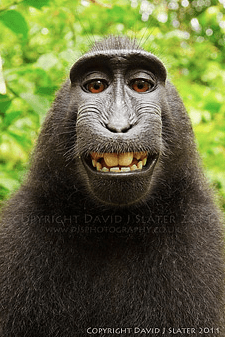
David Slater is a British wildlife photographer; he is most famous for his image of “the monkey that took its own photograph.” On a trip to Indonesia, he was following a group of Sulawesi macaques in the forest, in an attempt to connect with them and co-exist peacefully with them, while of course photographing them along the way. After a long day, Slater sat down close by to the group of monkeys for a rest, while they were having a group grooming session. Soon enough, the monkeys came closer and become grooming him too! They also took a liking to his camera and so the photographer placed the camera on his tripod with a very wide angle lens, predictive autofocus and a flashgun set, in the hopes of capturing a facial close up. His efforts were worthwhile as the monkeys began grinning and pulling faces in the lens of the camera, pressing all of the buttons and inevitably some photographs and “self portraits” were taken, including the iconic photo we now recognise today! However, his photo has caused Slater a lot of financial difficulty as he has been frequently dragged through the courts over the debate of copyright of the image; is Slater right to claim ownership of the image, or does the copyright belong to the monkey itself as he was the one who pressed the shutter?! This debate has opened up an interesting conversation about copyright and what is technically defined as a “self portrait.”
Screen Shot 2019-04-06 at 19.40.42

Francesca Woodman photographed herself in empty interiors, often nude or semi-nude, to portray her suffering with mental illness such as anxiety and depression. However, her pictures are not traditional self-portraits. In her images, she is usually half hidden by objects or furniture, or she appears as a ghostly blur. She plays with distorting reality into a surreal fantasy by squeezing herself into small cupboards or wrapping herself under wallpaper like a blanket; she often seems to be retreating and hiding within the materials of the building. The images create an underlying sense of human fragility, vulnerability and isolation, which is further exaggerated by the fact that the photographs are printed on a very small scale, making them seem personal and intimate. These images connect with me personally as I know how it feels to battle your own demons and I completely understand and am inspired by how Woodman can capture her inner feelings within a physical image.

Other Self Portrait photographers include:

  • Peter Kennard and Cat Picton
  • Hippolyte Bayard – took the first known self portrait
  • Nan Goldin
  • Claude Cahun – inspired by Cindy Sherman
  • Dorothy Wilding – first female photographer for a royal household
  • Marta Hoepffner
  • Vivian Maier
  • Wanda Wulz
  • Arno Rafael Minkkinen
  • Yves Klein
  • Lee Friedlander
  • Duane Michals
  • Phillip Toledano

The Place

“Place” refers to vast open spaces and landscapes. It includes mainly nature photography but it can also include man-made structures and urban areas; it has a very broad and flexible definition. When photographing a landscape, cutting out the sky can change it from simple being “a view” to a landscape photograph – framing is important!

There are four main types of landscape:

  • Natural landscape
  • Urban landscape
  • Social landscape (e.g street photography)
  • Psychological or Emotional landscapes (inner landscapes)

Robert Adams, a landscape photographer, said that there are three main elements to photographing places: Geography, Autobiography and Metaphor. Taken together, they strengthen and reinforce each other and create a successful and powerful photograph.

Pre-17th Century, landscape was confined only to the backgrounds of other genres. But after the 18th Century, there were three types of landscape photography:

  • The Sublime – awesome sights, nature at its most fearsome.
  • The Beautiful/Pastoral – inhabited landscape, smooth and ordered.
  • The Picturesque – ruins and incomplete buildings, gives an edgy feel.

Edward Burtynsky photographs manufactured and industrial landscapes, such as factories. He documents people and their place in relation to the world, and their impact on the environment. He photographs quarries and mines which document extraction in the landscape – begging the question “how long will our oils and fuels last if we continue?” He also photographs pollution, rubbish, recycling materials and landfill sites. Large factories are placed in our environment due to our consumer lifestyle; as humans, we use and dispose of things all the time. Man-made structures include roads, houses and cars which are also mass-produced and take a toll on the environment. However, Burtynsky wants to show that even industrial, urban or conventionally unattractive places can appear beautiful through a lens and the power of photography; landscapes don’t always have to be “beautiful” and “perfect.” His work is Post-New Topographics, the book of photographers that also photograph urban landscapes and focus on how humans are affecting and damaging the planet. He uses large format prints to capture every detail and make sure it’s visible.

Landscape photographers include:

  • Ansel Adams
  • Jitka Hanzlova
  • Liza Dracup
  • Albert Bierstadt
  • Noemie Goudal
  • Eugene Atget
  • Bill Brandt
  • Lewis Baltz
  • Stephen Shore
  • Bernd and Hilla Becher
  • Joel Sternfeld
  • Simon Roberts
  • Rut Blees Luxemburg
  • Edward Burtynsky
  • Richard Mosse
  • Ed Rusha


Oleg Oprisco – RESEARCH – Constructed Image

Oleg Oprisсo is a fine art photographer; he was born in the small city of Lviv, Western Ukraine. His interest in photography began when he worked in a photo lab for three years aged 16 years old, where he gained an understanding of the images and poses that were most liked by customers, and he still uses this as a reference for the work he produces today. In 2009, he switched formats from digital capture to film.

His images and creations often have deep, thoughtful meanings behind them. He photographs ‘real life’ scenarios, then manipulates the image to add other features such as people and props, creating a ‘dream-like’ or fantasy feel. He takes his inspiration from his everyday life, such as the things he sees on his way to work, and recognises that there is so much beauty to be found in everyday life; a view that I also personally share, and I want to capture this in my work. Everyday items may appear simple, but beauty can be found within them if we take the time to look and change our mindsets from viewing them as mundane.

Some inspiring examples of Oprisco’s work are below:

Wilson Hennessy – RESEARCH – Objects of Desire

Wilson Hennessy grew up on a farm in rural Australia; later in life he took a photography degree and assisted a number of top photographers until he began working on his own in 2008. He now shoots for editorial clients, including recent campaigns for companies such as Audi, Barclays, Vodafone and Shell. A particular focus of his work is automotives and cars, reflecting his recurring interest in motor vehicles and their mechanics from a young age to adult life.

He specialises in bright, colourful, graphic still life photography. His product photography has a very commercial feel and is professionally shot in the studio with immaculate lighting to showcase the products to their full potential and evoke feelings of desire from the viewer. His choice of subjects range from technical appliances like laptops, watches and cameras, to alcohol, shoes and food products; all items that are very commonly consumed within today’s society. His backgrounds are often bright, block colours that compliment the subject while still making the product the main focus of the image. The mixture of his eye-catching colour schemes, variety of interesting compositions, and bold graphic components all draw the viewer’s attention and encourage feelings of desire for the products he is promoting; these features also showcase his unique style and make his work easily recognisable and distinguishable from other artists.

Below are some examples of his work that have inspired me:

Historical Villages of Eyam & Castleton – VISUAL DEVELOPMENT – The Enigma of Time

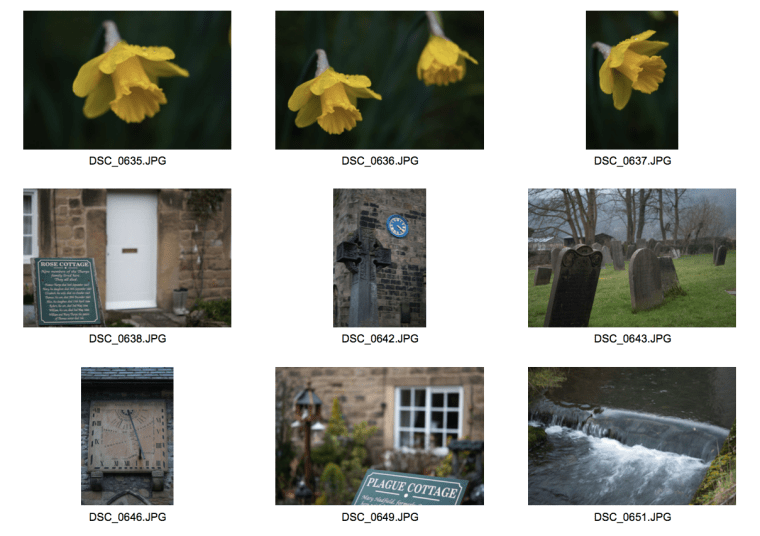
After being inspired by Eugene Atget and making the decision to photograph historical locations, I embarked on a trip to “The Plague Village” of Eyam to document the village’s dark history of the Plague or “Black Death.” After the disease was brought to the village from London in a piece of infected cloth in 1665, villagers selflessly decided to seal themselves off from the rest of the country and the outside world to avoid spreading the deadly disease to others, and the village still tells this story to this day. There are many plaques and boards detailing the story and the methods used to contain the disease, as well as monumental landmarks including the ones I visited and photographed, such as: the Plague Cottages where the victims of the disease once lived and modern families now inhabit; the Church of St Lawrence which dates back to Saxon times and features an eighth-century Celtic Cross and churchyard; and an old traditional Sheep Roast, plus many more attractions such as the museum which were unfortunately closed when I visited. I used my Nikkor Micro Prime Lens with a wide aperture to create an effective, shallow depth of field and focus on certain parts of the image, such as the “Plague Cottage” plaques to explain the backstory within the image and give some context.

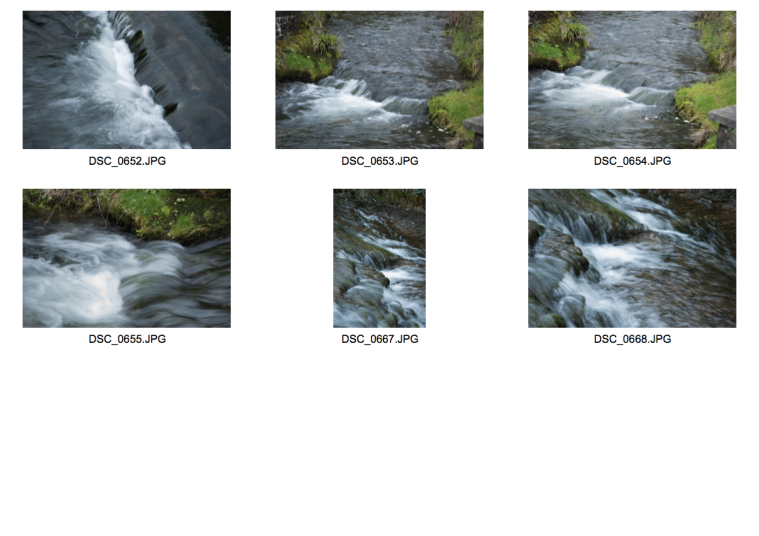
Afterwards, I visited the nearby village of Castleton and took a stroll along a lake, capturing the moving water using a slow shutter speed of about 1/8th of a second, and balancing the camera on the stone wall to minimise camera shake. I also took the opportunity to photograph some dandelions with a shallow depth of field which were inspired by Atget’s photographs of flowers in a similar style.

Here are the original images:

This slideshow requires JavaScript.

Next, I narrowed down the most successful images and edited them in Camera Raw, ensuring none of the highlights or shadows were blown out with the clipping warnings, adjusting the exposure and straightening any horizontal or vertical lines that needed tidying up. Below are the final images:

Screen Shot 2019-03-03 at 04.05.37Screen Shot 2019-03-03 at 04.05.48

Eugène Atget – RESEARCH – The Enigma of Time

Eugene Atget was a French photographer; he was born in 1857 and died in 1927. His career bridged the 19th and 20th centuries, during which time he worked in around Paris for 35+ years. He created an “encyclopaedic, idiosyncratic lived portrait of that city on the cusp of the modern era.” In other words, he created an informative yet peculiar picture of the city of Paris, with the aim to capture the beauty of the city before it became completely modernised.

He first began his career around 1890 by hanging a shingle on a studio door in Paris, reading “Documents pour artistes” (Documents for artists). His ambition was to provide other artists with images to use as a source for their own work, including images from some of the following genres: landscapes, flowers, foregrounds for painters, and reproductions of paintings, plus many more. His entry into the field of photography coincided with the invention of dry-plate photography, which made it easier to create photographs quickly, while the rise of photomechanical reproduction allowed photographs to be distributed widely. However, despite these technological advancements, Atget used a large format view camera to capture his images in detail, and large glass plates measuring about 18 x 24 cm.

In around 1900, his interest in vieux Paris (“old Paris”) took centre stage, and Atget went on to established himself as a ‘specialist in pictures of Paris.’ His documentary vision was highly influential, especially for the Surrealists. He photographed deserted streets and stairways, street life and shop windows, which the Surrealists found beguiling and richly suggestive. Most of his images were taken at dawn, and are notable for their use of diffused light and wide views that create a sense of space and ambience.

Upon looking at Atget’s work, I have been inspired to take a slight documentary style approach to the Enigma of Time assignment. I have decided to experiment with photographing historical sites and buildings to represent time in my images and document these sites in their current, modern state, similar to Atget’s work. Unfortunately I can’t capture the sites before they became modernised like when Atget captured “old Paris,” but I will capture them in their current state which will document how they have aged with time and been preserved. One of the locations I intend to visit is the historic village of Eyam in the Derbyshire Dales, also known as the “Plague Village” because of it’s incredible backstory: in the 1600s, its unselfish villagers sealed themselves off from the outside world to prevent the deadly disease from spreading to other communities. I think photographing the village and attempting to capture the narrative of its history will be an interesting challenge and produce some effective images.

I have taken inspiration from the below images:

PHOT40151: The Photographers Eye: Introduction and Initial Thoughts

This module is based on the publication “The Photographer’s Eye” by John Szarkowski. I have been asked to implement his ideas into my own photographic work, by developing my creative image processes. I must produce four prints for each of the following themes: Objects of Desire, The Enigma of Time, and The Constructed Image.

As the brief says, Objects of Desire requires me to evoke the feeling of desire within my images, with my own choice of subject, studio or location shooting, flash or ambient lighting, etc. With the popularity of online shopping and social media, we see many images everyday of items that evoke these feelings of desire within us, such as food, cars and fashion; however we often don’t stop to consider how these images were constructed, and how they provoke a response such as persuading us to purchase or use something, or otherwise affect us in some way.

My initial thoughts on this theme are that I will begin to experiment with studio lighting and produce images with a commercial style/theme. I like how the images in this genre of photography have a great emphasis on lighting and create a huge impact on the viewer; I would like to explore this avenue to further develop my understanding of lighting within photography and how this can affect the way an image and the subject looks. I have purchased a portable photography studio complete with lighting which will enable me to experiment with this idea from home. Initial ideas for subjects include flowers such as roses; these are very romantic which play on the theme of Desire, and I have also purchased some fabrics with a velvet feel to further evoke desire and to compose more unique photographs than the stereotypical flower shots you would usually see. There are many variations of flowers which will enable me to expand on this idea further as I go along.

The Enigma of Time relates to one of the key elements that Szarkowski states in his book “define the medium of photography:” Time. Therefore, I am asked to produce four images that simply use Time in some way to affect how they look. Again, I am given free reign over the choice of location and lighting, as long as my images evoke a response from the viewer.

Initial ideas for this theme include using motion blur in some of my images to depict the idea of movement and time; I will be attending the university trip to New York where I hope to use this technique to show how busy the city is and how it “never sleeps.” This technique can also be experimented with anywhere local that is busy with plenty of movement such as busy roads and city centres, shooting anything from vehicles to people. Another idea for this theme that I recently had was to recreate some of my first photographs with my boyfriend from 6 years ago, therefore showing how our appearances have changed with time but if I can take them in exactly the same places then I can also show how our surroundings have changed, too. I feel that this would evoke a response from the viewer to start wondering how our emotions, thoughts and our lives in general have changed too; prompting them to think further and deeper than just the outward appearance.

The Constructed Image encourages us to think more about the construction of our photographs, by using techniques such as montage, collage, multiple exposure, multiple printing and the combination of image and text, to create complex and dynamic images beyond “the straight frame” or the ordinary. Again, I must produce four images that somehow use the techniques above by making creative and unique decisions, without emulating others’ work.

This theme, I feel, is the most broad out of the three. This has both positive and negative aspects, as it allows me to be completely free with my subject choice and the techniques that I undertake; however, this can make it very tricky to know where to begin with my experiments. My previously mentioned idea about reconstructing past images could also be used here for this theme, as it could prove effective to montage the old and new images together to create something entirely unique; I will consider which theme this idea suits best. After some consideration and research, I have also had the idea to photograph the local area and countryside where I have grown up, and take many shots of one scene to later arrange and piece together into a photomontage, similar to a jigsaw and creating a new dynamic to the photograph, rather than a normal, straight, rectangular image. I will play with this idea and see where it takes me.