Sakir Gökçebag – RESEARCH – Everyday Geometry

Born in 1965 in Denizli, Sakir Gökçebag is a Turkish photographer and installation artist. In 1987 he graduated from the Faculty of Fine Art at Marmara University; he then went on to complete his masters degree 1990 and his doctoral degree in 1994. He has taken part in many group exhibitions in Turkey and abroad, as well as many of his own solo exhibitions. In 1991, Gökçebag won the second prize in the State Painting and Sculpture Competition in Ankara. He was also awarded the Markus Lüpertz Prize by Düsseldorf Academy in 1996.

In particular, Gökçebag’s geometric food art inspires me for the Everyday Geometry project. One of my initial ideas was to use fruit for this project, and viewing this photographer’s work has shown me how successful, unique images can be made even with quite simplistic objects. He arranges and organises various fruits and vegetables into striking patterns and displays, without the use of digital manipulation. This has encouraged me to produce geometric shapes in the “real world” without relying on Photoshop or other digital manipulation software, which can be very tempting to do in the digital age. This will also give a more authentic feel to my images.

Pinterest Boards – RESEARCH

To help inspire me and generate some more ideas for my assignments, I took to Pinterest to look at other people’s photos that may positively influence my work. I have saved a wide variety of examples for each assignment to look at whenever I need motivation and ideas. Pinterest is a very creative platform, therefore I chose this website to create my mood boards because it is most effective at helping me generate creative thoughts, with the added bonus that there are useful articles attached to some of the images with handy photography tips, such as successful poses for portrait photography.


Light and Shadow

Screen Shot 2018-11-18 at 20.24.09

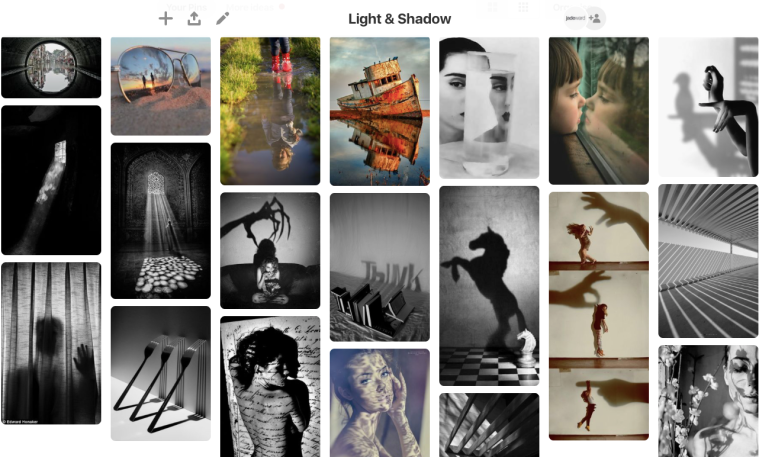
I find the images of buildings and fences on this board very interesting and they are similar to the work I produced in my previous photoshoot for the Light and Shadow assignment in Hanley in the abandoned bus station. Moving forward, I also find the images with reflections very intriguing and this was one of my initial thoughts for this project. I may take this direction next and see how successful the outcome is. Reflections can be found in many places such as bodies of water, windows and reflective surfaces such as the pair of glasses above. I also like the idea of the shadows on the wall which interact with the physical subjects in the images above, such as the woman watching the scary movie on the sofa.


Everyday Geometry

Screen Shot 2018-11-18 at 20.25.08

Screen Shot 2018-11-18 at 20.25.38

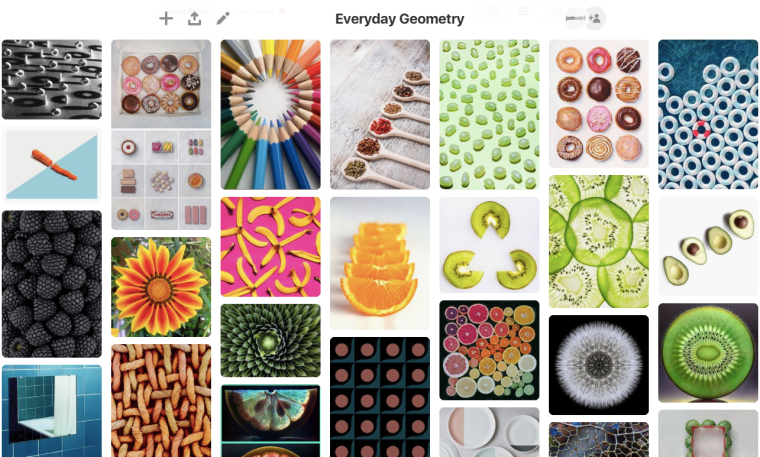
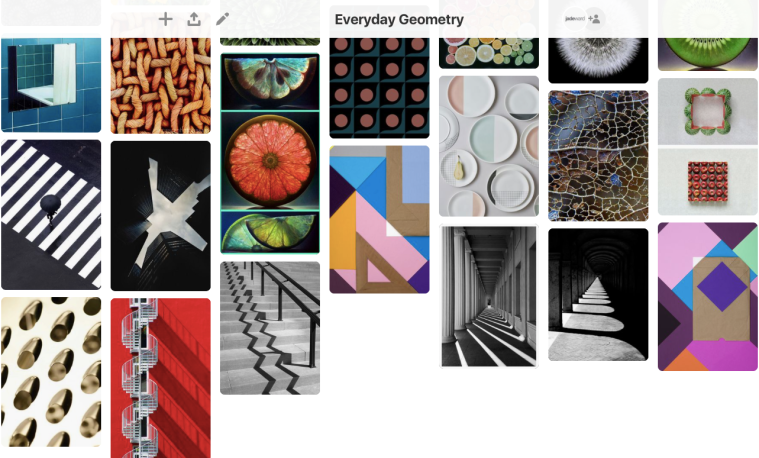
I found a lot of inspiration for this assignment as I was particularly struggling to find ideas for what to photograph, due to the 2cm height limit for the images and the flat lay style. From this research, I have decided to separately photograph slices of fruit, some pencils and some biscuits that will all be below 2cm and will be placed on coloured card to create an aesthetically pleasing background, especially when the colour of the subjects contrast against them. The items themselves will be shaped geometrically, but I will also arrange them in other shapes to further carry the theme through the images. Fruit is particularly interesting because there are natural shapes hidden within them, such as inside kiwis, lemons and limes. I was also inspired to look for more geometric shapes around me within daily life, such as buildings and in the objects we use around the house daily.


Who’s Who?

Screen Shot 2018-11-18 at 20.30.01

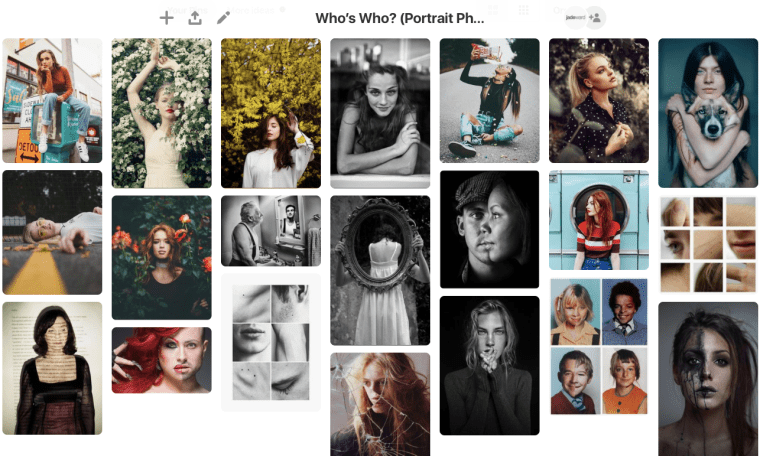
This mood board is a mixture of aesthetically pleasing images and ones that hold a deeper meaning, such as the old gentleman looking into the mirror with the reflection of his younger self. I like the idea of having a deep meaning behind my images, as I would like to use photography to communicate ideas and get people thinking. However I also like the idea of not having to include any deeper meaning, and simply produce images because they look nice. I think adding a deeper meaning to my images may be more difficult for this assignment as I am required to photograph people I don’t know, and therefore I don’t know their stories. I am initially very nervous and shy about approaching people, so I will experiment with taking simple, pretty images and see how much my confidence grows. Very effective images can still be made, simply by using an effective background or location.

Humans of New York by Brandon Stanton – RESEARCH – Who’s Who

“Humans of New York began as a photography project in 2010.  The initial goal was to photograph 10,000 New Yorkers on the street, and create an exhaustive catalogue of the city’s inhabitants.”

– Brandon Stanton

Stanton’s project, Humans of New York, involves photographing strangers and everyday people on the streets of New York. After a while, he began to interview his subjects in addition to photographing them, including quotes and short stories from their lives alongside their photographs, which he publishes on his blog and in two bestselling books, Humans of New York and Humans of New York: Stories. The blog now has over twenty million followers on social media; due to its success, it has also expanded to tell the stories of people from over twenty different countries, giving the audience a daily insight into the lives of strangers and people on the streets. I think this concept is really interesting as every single person on this earth has their own unique story, and it’s intriguing to see how our own lives differ or are similar to people from completely different backgrounds and countries, that we would otherwise know nothing about. I also feel that adding these captions and stories adds another dimension to the portrait photographs, as you are not only seeing the person’s outward appearance, but also learning something about their lives and personalities, too.

Below are some examples of Stanton’s work from this series:

Ernst Haas – RESEARCH – Everyday Geometry

Ernst Haas was born in 1921 in Vienna, and is known as “one of the most celebrated and influential photographers of the 20th century.” He first took up photography after the war, and was recognised by LIFE magazine thanks to his early work on Austrian returning prisoners of war. In order to keep his independence, he declined a job offer as a staff photographer; he then went on to develop close associations with high profile photographers such as Henri Cartier-Bresson, when he joined Magnum in 1949.

Shortly after moving to the United States in 1951, he began photographing in black and white in the New Mexico desert, where he developed a great desire for colour. He then began experimenting with Kodachrome colour film, and would later become the premier colour photographer of the 1950s! His ground-breaking 24-page colour photo essay on New York City was published by LIFE magazine in 1953, which was the first time such a large colour photo feature was published in the magazine. It is said that “before Haas there was no colour photography, only coloured photographs.” He photographed for many influential publications such as Vogue, LIFE and Look, travelling extensively throughout his career. He also authored four books: The Creation (1971), In America (1975), In Germany (1976), and Himalayan Pilgrimage (1978).

Haas received the Hasselblad award in 1986, the year of his death, and has continued to be the subject of many museum exhibitions and books, such as the quite recent publication Color Correction in 2011. His legacy continues thanks to The Ernst Haas Studio, located in New York, which helps to aid researchers and oversees all projects related to his work.


Below is a quote by Haas which I find inspirational:

“There is no formula – only man with his conscience speaking, writing and singing in the new hieroglyphic language of light and time.”

Ernst Haas

I interpret this quote as him saying that there is no “magical formula” in photography; we, as photographers and people, can only express our feelings and emotions in this medium, which he describes as a language of pictures (hieroglyphics), made up of light and a particular moment in time.


Some examples of Haas’ work that inspire me for the “Everyday Geometry” project include:

Trent Parke – RESEARCH – Light and Shadow

Trent Parke is an Australian photographer who was born in 1971, and raised in Newcastle, New South Wales. He first began taking pictures when he was around 12 years old, using only his mother’s Pentax Spotmatic (a 35mm single-lens reflex camera), and the family laundry as his darkroom. Today, he works primarily as a street photographer, and is the only Australian photographer to be represented by Magnum Photos.

He uses hard light to transform urban landscapes into something less familiar. The shadows form large areas of black, which mask unnecessary detail. This causes our eyes to be drawn to the highlights in the image. (Carroll, 2014).


(Left: Adelaide. Heinley Street, 2006. Right: Adelaide. Pulteney Street, 2006).

His collection Minutes to Midnight was produced in 2003 with his wife and fellow photographer, Narelle Autio, while they drove almost 56,000 miles around Australia on a two-year road trip. “The work is both a document of a changing nation, uneasy with its identity and its place in the world, and a work of fiction which when combined suggests the build-up, aftermath and rebirth of an apocalyptic world” (Magnum Photos, n.d.). Parke was awarded the W. Eugene Smith Grant in Humanistic Photography for this project.

Image result for trent parke minutes to midnight    Image result for trent parke minutes to midnight

(Above: Minutes to Midnight)

Parke has published two books: the first being Dream/Life in 1999, and the second being The Seventh Wave in collaboration with his wife Narelle Autio in 2000. He was also granted the ABN AMRO Emerging Artist Award in 2006, and won World Press Photo Awards in 1999, 2000, 2001 and 2005.

Assignment 1: Initial Thoughts

This assignment excites me because I am free to be as creative as possible; the subject matter is completely open, meaning the possibilities are endless and I can interpret each subject in any way I like. However, this can also be daunting because it can be hard to decide where to start, or which ideas to take forwards. Furthermore, I think this assignment will help further develop my photographic eye by encouraging me to explore how light affects and changes the things around me, and how this can communicate different things to the viewer.

Part A: Light and Shadow

This subject excites me the most because it is so broad and I feel like it allows the most freedom and creativity. I would like my images for this subject to have depth and evoke feelings and emotions from the viewer. Shadows are effective in creating a certain mood or atmosphere, possibly with a sinister feel; whereas bright, white lighting is associated with more positive, happy feelings. I plan to experiment with different variations of lighting to see what kind of emotions these evoke, and how lighting affects the shadows. I can also use light and shadow to create visually pleasing images, as not all photography must have a particular idea or concept behind it; spontaneous shots can be just as effective!

Part B: Everyday Geometry

The first thing that comes to mind about this subject is food photography. The assignment states that the objects used to create the geometric compositions must be relatively flat and no higher than 2cm; food can be sliced and cut into thin pieces to meet this criteria. Many foods are also already shaped geometrically: donuts, sweets, biscuits, lemons, limes, oranges and berries, to name a few. Many of these items are colourful and therefore I can create some strange and interesting compositions by contrasting them against the background. However, I won’t limit myself to only using foods and will experiment with other everyday objects too. Geometric patterns are often aesthetically pleasing for the viewer, but I may also be able to create some evocative images by experimenting with the light and shadow.

Part C: Who’s Who?

This is another subject that interests and excites me because I am a very open minded person, and I can already imagine lots of different ideas to create evocative images by challenging the way we perceive people, simply by judging their outward appearance. I am required to take pictures of people that I don’t know, which is something very far out of my comfort zone, however I plan to embrace this and I think it will be interesting to learn about new people who maybe I wouldn’t usually speak to. Furthermore, I think it would be really interesting to challenge stereotypes in this part of the assignment; I could juxtapose a photograph showing the image we create of people from the way they dress or look, alongside an image portraying the “real” person and their true personality, which may be the complete opposite of the initial assumption of the person. Another idea would be to take a natural photo of people in the street, and ask them for an interesting or unusual fact about themselves that nobody else would know. This may also create a juxtaposition and get the viewer thinking about how the image we create about someone based on their appearance isn’t necessarily who they truly are.

Next, I plan to create some Pinterest boards to find some examples similar to the ideas I already have, and also find some inspiration for other ideas I could pursue. I will also research into some artists and photographers who inspire my work and work in similar ways themselves, and begin my visual development by undertaking practice shoots to experiment with my ideas.