FINAL IMAGES – VISUAL DEVELOPMENT

Light and Shadow

This slideshow requires JavaScript.

I chose these images as my final 4 as they are by far the most effective images. The urban feel from the abandoned bus station and the black and white effect gives the images an interesting and mysterious feel to them, and the desaturation also makes the contrast between the light and shadows stand out. I also think these images have visual impact when you look at them for the above reasons.


Everyday Geometry

This slideshow requires JavaScript.

The reason I chose the above images for this assignment was because they are the most accurate of the images I have produced; it’s incredibly difficult to get these kind of images 100% perfect, but I feel that these are as close as it gets. I also really like the impact these images have from the bright coloured backgrounds which compliment the colours of the subjects themselves, thanks to using the colour wheel for reference. Biscuits are also a less obvious subject choice than fruit, and I feel that the variety in compositions compliment each other well.


Who’s Who

This slideshow requires JavaScript.

These images are my final 4 because the concept of “what makes us unique” got me really intrigued and I feel like my results were so successful because of this genuine interest in the concept. I also feel like the extreme close-ups provide a unique perspective to the assignment that other people may not have produced, as it is easy to look at this brief and take a standard, stereotypical “portrait” image of the person’s face and shoulders, and I wanted to produce something more bold and with a deeper meaning. I also think the black and white effect combined with the close-up composition make the images feel very intimate and beautiful to look at.


Printing these images was a difficult task to understand at first, but after I got the hang of it I really enjoyed seeing my images printed in a physical copy in front of me. I chose Permajet Matte paper in 285gsm and Royal Gloss in 310gsm to create a professional feeling thickness and quality to the paper, to avoid them being flimsy or low quality. I chose Matte paper for the Light and Shadow images as I felt like avoiding the glare from glossy papers would show up more of the details and shadows in the images more successfully. I then chose the Royal Gloss paper for Everyday Geometry so that the shiny, glossy effect would further make the bright colours stand out and really make them pop, and the same paper type for Who’s Who to give the black and white images an even more luxurious feel and make the intimate details on the subject’s face really stand out. I ensured that each set of 4 images was placed in the exact same place on each page to successfully communicate they are part of a set, and used a slightly different composition for each set to keep them separate from each other. I used a white border around the edges to frame them and make further use of the space on the page.
Teggs Nose – VISUAL DEVELOPMENT – Light and Shadow

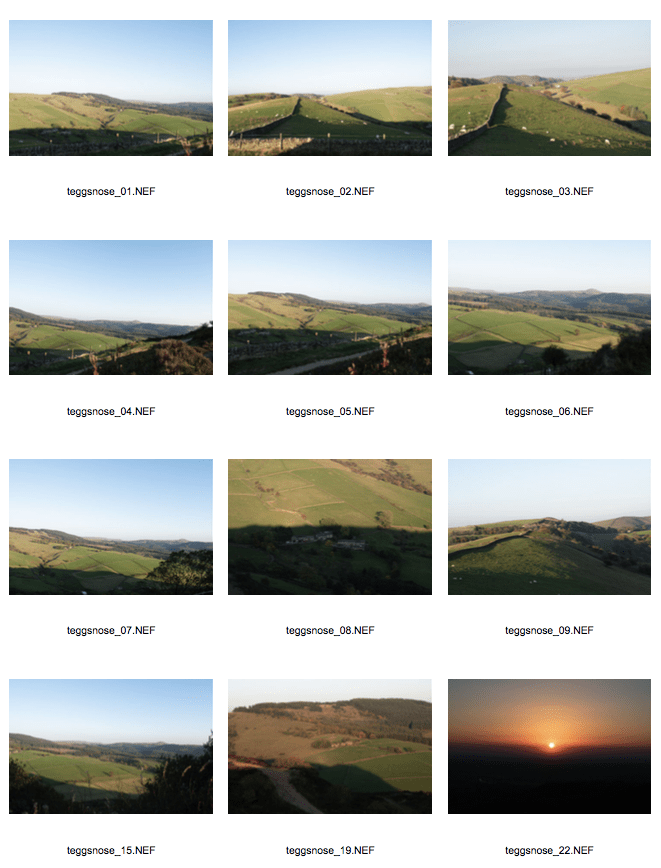
Another experimental shoot I undertook for the Light and Shadow assignment was a trip to a local country park called Teggs Nose. This particular day, the sun was shining bright and the many brick walls and fences were casting shadows across the stunning country fields. I decided to take out my camera and again experiment with the exposure settings (shutter speed, ISO and aperture) to effectively capture these shadows and areas of contrast in the fields. My hometown of Macclesfield is quite a rural area and so capturing the light and shadows in this type of area also adds a personal touch to my assignment as it feels like home to me and therefore adds some personality into my work. I enjoy shooting landscapes in particular, and so I like the element of capturing light and shadows for the assignment brief, but also adding a personal touch and more depth to the images by also capturing a successful landscape photograph which can be used in both circumstances.

One thing in particular that caught my eye were the houses and outbuildings that were hiding in the shadows of the hill which was the vantage point I was standing on, as seen in the image “teggsnose_08.NEF.” This could be interpreted in many ways by the viewer, such as the people living in this house are hiding away in the shadows, separated from the rest of the world that are living in the light.

When I presented these images in a group tutorial, the feedback I was given mentioned that these images focus heavily on shooting the landscape itself and aren’t so focused on the shadows themselves. The image of the house hiding in the shadows was praised as this shows that I am paying closer attention to the shadows in the scene, rather than the surrounding landscape. I don’t think I will use these images as my final pieces as country fields and landscapes are quite commonly photographed and could be perceived as “boring,” and I would like my final images to stand out for the right reasons.

Below is a contact sheet of the images from this shoot:

Screen Shot 2018-12-09 at 21.40.09

Shadows Around The Home – VISUAL DEVELOPMENT – Light and Shadow

After the initial shoot in Hanley for Light and Shadow, I was very happy with the images I produced, however I still wanted to look around for more ideas and the easiest, most sensible place to look was around my home. In doing this, I noticed that the chandelier in my bedroom casts shadows in interesting patterns and lines on my ceiling when the light is switched on, which appear in a repetitive and aesthetically pleasing pattern. These images were mostly for test purposes to experiment with capturing shadows and exploring how light and the surrounding objects can affect the shadows that are produced. I feel like this has also helped me understand the exposure on my camera more when shooting areas with light and dark areas, and areas of contrast.

Henri Cartier-Bresson – RESEARCH – Light and Shadow

Cartier-Bresson was born in Chanteloup-en-Brie, Seine-et-Marne in 1908. He developed a strong fascination with painting early on in his life, particularly with the subjects of Surrealism and Cubism. His camera of choice became the Leica, after spending a year in the Ivory Coast in 1932. After this moment, he began his life-long passion for photography. He created the Fondation Henri Cartier-Bresson in Paris in 2003 for the preservation of his work. Over his lifetime, he received an extraordinary number of prizes, awards, and honorary doctorates.

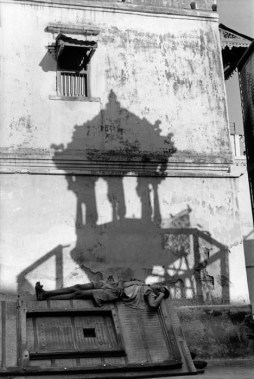
One of the main features of Cartier-Bresson’s work is “shadow play.” Shadows are areas that lack light; photography itself is all about painting with light, and you can’t have light without dark. Shadows can add another layer to our images, even creating two scenes within one frame by overlaying shapes and textures over any other given scene. An example of this is the below image of Cartier-Bresson’s, where what appears to be the shadow of a mosque is cast on the wall of another building. This adds religious connotation to the image which otherwise wouldn’t be there.

theory-of-composition-shadowplay

“While other photographers work around shadows, Cartier-Bresson uses them as little jokes, surrealist tools, and moveable backdrops to transform ordinary street scenes into photographs that make us wonder “How come I did not see that?”

Pinterest Boards – RESEARCH

To help inspire me and generate some more ideas for my assignments, I took to Pinterest to look at other people’s photos that may positively influence my work. I have saved a wide variety of examples for each assignment to look at whenever I need motivation and ideas. Pinterest is a very creative platform, therefore I chose this website to create my mood boards because it is most effective at helping me generate creative thoughts, with the added bonus that there are useful articles attached to some of the images with handy photography tips, such as successful poses for portrait photography.


Light and Shadow

Screen Shot 2018-11-18 at 20.24.09

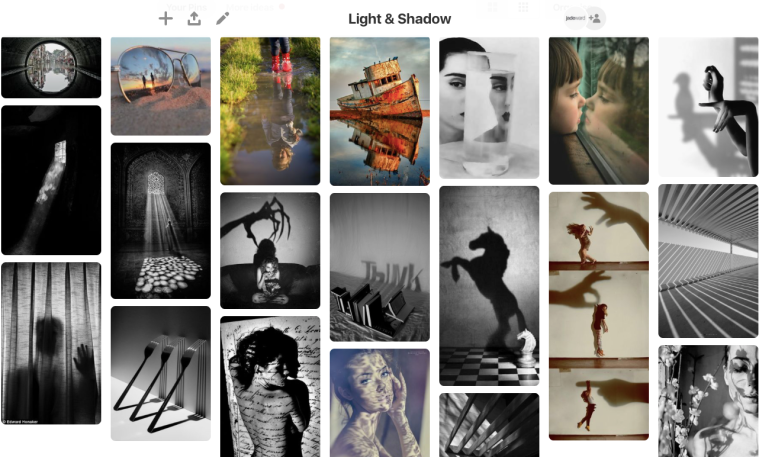
I find the images of buildings and fences on this board very interesting and they are similar to the work I produced in my previous photoshoot for the Light and Shadow assignment in Hanley in the abandoned bus station. Moving forward, I also find the images with reflections very intriguing and this was one of my initial thoughts for this project. I may take this direction next and see how successful the outcome is. Reflections can be found in many places such as bodies of water, windows and reflective surfaces such as the pair of glasses above. I also like the idea of the shadows on the wall which interact with the physical subjects in the images above, such as the woman watching the scary movie on the sofa.


Everyday Geometry

Screen Shot 2018-11-18 at 20.25.08

Screen Shot 2018-11-18 at 20.25.38

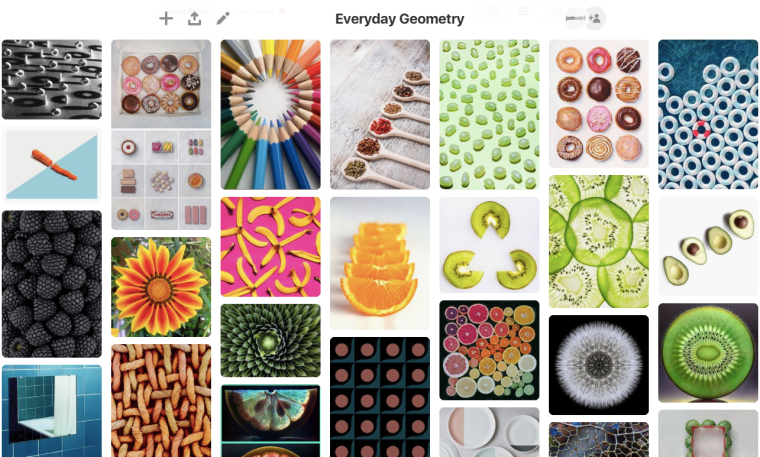
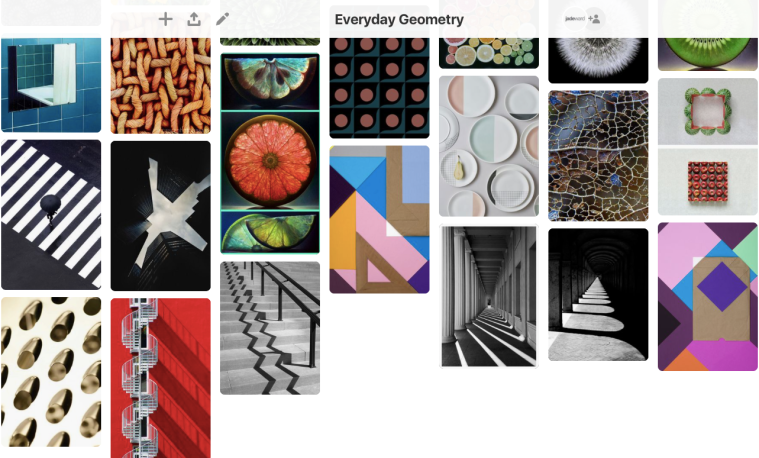
I found a lot of inspiration for this assignment as I was particularly struggling to find ideas for what to photograph, due to the 2cm height limit for the images and the flat lay style. From this research, I have decided to separately photograph slices of fruit, some pencils and some biscuits that will all be below 2cm and will be placed on coloured card to create an aesthetically pleasing background, especially when the colour of the subjects contrast against them. The items themselves will be shaped geometrically, but I will also arrange them in other shapes to further carry the theme through the images. Fruit is particularly interesting because there are natural shapes hidden within them, such as inside kiwis, lemons and limes. I was also inspired to look for more geometric shapes around me within daily life, such as buildings and in the objects we use around the house daily.


Who’s Who?

Screen Shot 2018-11-18 at 20.30.01

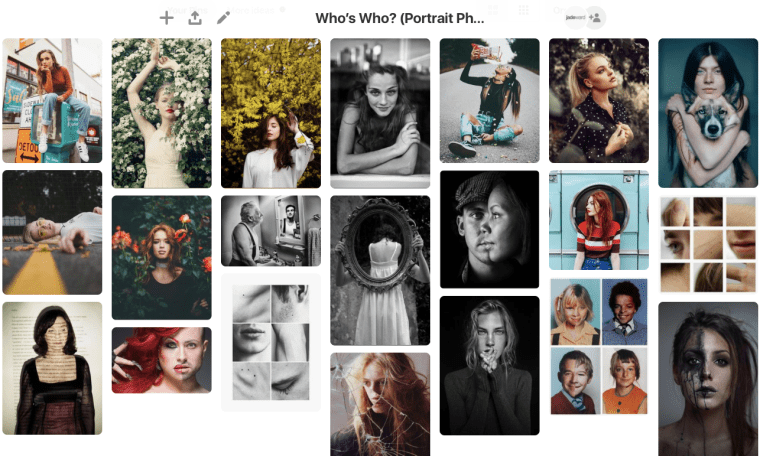
This mood board is a mixture of aesthetically pleasing images and ones that hold a deeper meaning, such as the old gentleman looking into the mirror with the reflection of his younger self. I like the idea of having a deep meaning behind my images, as I would like to use photography to communicate ideas and get people thinking. However I also like the idea of not having to include any deeper meaning, and simply produce images because they look nice. I think adding a deeper meaning to my images may be more difficult for this assignment as I am required to photograph people I don’t know, and therefore I don’t know their stories. I am initially very nervous and shy about approaching people, so I will experiment with taking simple, pretty images and see how much my confidence grows. Very effective images can still be made, simply by using an effective background or location.

Hanley Photoshoot – VISUAL DEVELOPMENT – Light and Shadow & Everyday Geometry

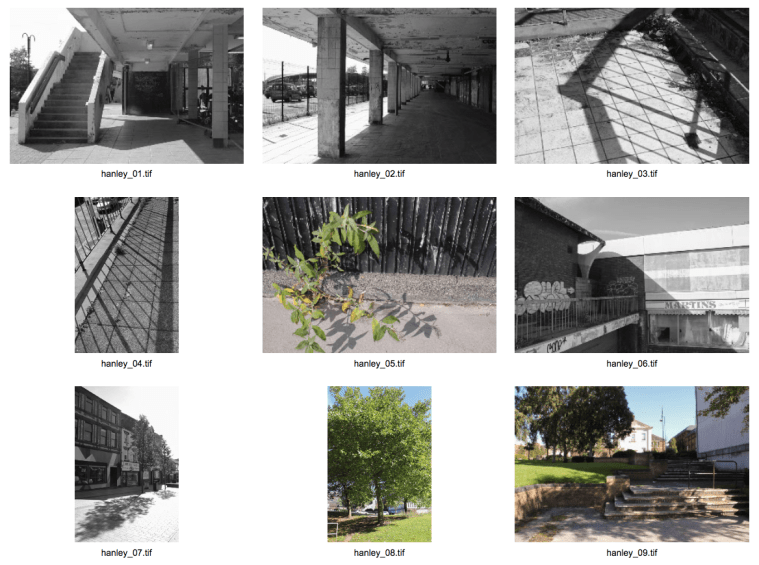
On 25/09/18 I ventured into Hanley town centre with one of my fellow students to embark on our first photoshoot for these assignments. The main purpose of this trip was to experiment and get used to our cameras, look for some initial ideas and create some initial images. It was very sunny on this day which was particularly perfect for the Light and Shadow assignment. We began our photographic journey at the old abandoned bus station; this area had a mysterious ‘urban’ atmosphere which intrigued me, and the buildings and railings casted many shadows that attracted my photographic eye. Some of the graffiti was also very eye-catching and I enjoyed experimenting and capturing this artwork with my camera. Next, we walked around the town centre and captured more interesting shadows; I also spotted many different geometric shapes that inspired me for the Everyday Geometry assignment, and so I took the opportunity to photograph these for some initial ideas. I was surprised how many geometric shapes and patterns can be found in everyday places and situations (e.g. the brick road in ‘Hanley_31.jpg’ and the windows on the office building in ‘Hanley_42.jpg.’ I feel that this has really opened my eyes to the possibilities for this assignment.

Below is a slideshow of the contact sheets I produced for this photoshoot:

This slideshow requires JavaScript.


UPDATE: 25/10/18

After completing a computer workshop with Mark, I decided to put the editing techniques I had learnt into practice. I chose my favourite images from this shoot, and opened them up in Camera Raw to adjust them. This can be done by altering the Histogram in the top right corner, which gives you a visual indication of the Highlights, Mid-tones and Shadows in the image. I also adjusted the sliders on the right hand side to adjust elements of the images such as Temperature, Tint, Exposure and Contrast. I chose to change the Treatment to Black and White for most of the images, as I feel that this effectively brings out the areas of light and shadow and draws the viewer’s attention to these areas, which is important for the Light and Shadow assignment.


Below is a contact sheet of the final edited images from this shoot:

(Light and Shadow assignment)

Screen Shot 2018-10-29 at 17.40.48

Trent Parke – RESEARCH – Light and Shadow

Trent Parke is an Australian photographer who was born in 1971, and raised in Newcastle, New South Wales. He first began taking pictures when he was around 12 years old, using only his mother’s Pentax Spotmatic (a 35mm single-lens reflex camera), and the family laundry as his darkroom. Today, he works primarily as a street photographer, and is the only Australian photographer to be represented by Magnum Photos.

He uses hard light to transform urban landscapes into something less familiar. The shadows form large areas of black, which mask unnecessary detail. This causes our eyes to be drawn to the highlights in the image. (Carroll, 2014).


(Left: Adelaide. Heinley Street, 2006. Right: Adelaide. Pulteney Street, 2006).

His collection Minutes to Midnight was produced in 2003 with his wife and fellow photographer, Narelle Autio, while they drove almost 56,000 miles around Australia on a two-year road trip. “The work is both a document of a changing nation, uneasy with its identity and its place in the world, and a work of fiction which when combined suggests the build-up, aftermath and rebirth of an apocalyptic world” (Magnum Photos, n.d.). Parke was awarded the W. Eugene Smith Grant in Humanistic Photography for this project.

Image result for trent parke minutes to midnight    Image result for trent parke minutes to midnight

(Above: Minutes to Midnight)

Parke has published two books: the first being Dream/Life in 1999, and the second being The Seventh Wave in collaboration with his wife Narelle Autio in 2000. He was also granted the ABN AMRO Emerging Artist Award in 2006, and won World Press Photo Awards in 1999, 2000, 2001 and 2005.

Assignment 1: Initial Thoughts

This assignment excites me because I am free to be as creative as possible; the subject matter is completely open, meaning the possibilities are endless and I can interpret each subject in any way I like. However, this can also be daunting because it can be hard to decide where to start, or which ideas to take forwards. Furthermore, I think this assignment will help further develop my photographic eye by encouraging me to explore how light affects and changes the things around me, and how this can communicate different things to the viewer.

Part A: Light and Shadow

This subject excites me the most because it is so broad and I feel like it allows the most freedom and creativity. I would like my images for this subject to have depth and evoke feelings and emotions from the viewer. Shadows are effective in creating a certain mood or atmosphere, possibly with a sinister feel; whereas bright, white lighting is associated with more positive, happy feelings. I plan to experiment with different variations of lighting to see what kind of emotions these evoke, and how lighting affects the shadows. I can also use light and shadow to create visually pleasing images, as not all photography must have a particular idea or concept behind it; spontaneous shots can be just as effective!

Part B: Everyday Geometry

The first thing that comes to mind about this subject is food photography. The assignment states that the objects used to create the geometric compositions must be relatively flat and no higher than 2cm; food can be sliced and cut into thin pieces to meet this criteria. Many foods are also already shaped geometrically: donuts, sweets, biscuits, lemons, limes, oranges and berries, to name a few. Many of these items are colourful and therefore I can create some strange and interesting compositions by contrasting them against the background. However, I won’t limit myself to only using foods and will experiment with other everyday objects too. Geometric patterns are often aesthetically pleasing for the viewer, but I may also be able to create some evocative images by experimenting with the light and shadow.

Part C: Who’s Who?

This is another subject that interests and excites me because I am a very open minded person, and I can already imagine lots of different ideas to create evocative images by challenging the way we perceive people, simply by judging their outward appearance. I am required to take pictures of people that I don’t know, which is something very far out of my comfort zone, however I plan to embrace this and I think it will be interesting to learn about new people who maybe I wouldn’t usually speak to. Furthermore, I think it would be really interesting to challenge stereotypes in this part of the assignment; I could juxtapose a photograph showing the image we create of people from the way they dress or look, alongside an image portraying the “real” person and their true personality, which may be the complete opposite of the initial assumption of the person. Another idea would be to take a natural photo of people in the street, and ask them for an interesting or unusual fact about themselves that nobody else would know. This may also create a juxtaposition and get the viewer thinking about how the image we create about someone based on their appearance isn’t necessarily who they truly are.

Next, I plan to create some Pinterest boards to find some examples similar to the ideas I already have, and also find some inspiration for other ideas I could pursue. I will also research into some artists and photographers who inspire my work and work in similar ways themselves, and begin my visual development by undertaking practice shoots to experiment with my ideas.

PHOT40106 / VISUAL COMMUNICATION, JADE WARD, SUPPORTING WORK: Introduction

This assignment is split into three parts:

  • Part A: Light and Shadow
  • Part B: Everyday Geometry
  • Part C: Who’s Who?

I must create four images for each part of the assignment. I must use composition, colour, tone, light and shadow effectively within my images, to show an understanding and awareness of these elements and create observed and controlled images.

This blog will include all of my supporting work: including Visual Development and Research. I will use the ‘Categories’ feature to categorise each post according to the three parts of the assignment listed above; I will also use the ‘Tags’ feature to state what kind of post I am creating (visual development or research). These will be accessible via the Footer at the bottom of the page and will help organise the blog and make it easier to read and mark.