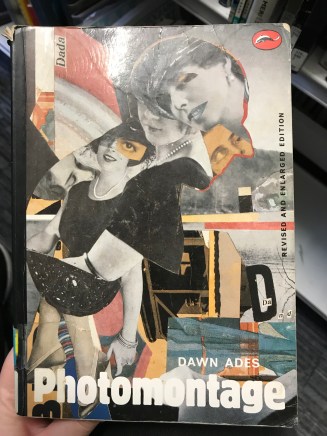
While browsing the university library for books relating to my essay, I came across this book, “Photomontage” by Dawn Ades, and thought it would be a great idea to browse the pages to look for inspiration for the Constructed Image assignment. I have found this assignment the most difficult out of the three; although I appreciate a broad brief because it allows lots of creative freedom, it can prove tricky to choose which of your ideas will be the most successful and what subjects are most suitable to use, and therefore which ideas to take forward and pursue.
Photomontage and Collage are two of the processes that we can try for this assignment, and I like the idea of incorporating more than one photo into an image to create weird and wacky artwork, such as the work created by the Surrealists. A combination of images in this way can create something unreal and “fantasy” like, because people, places and objects can all be pictured together that maybe would never usually be pictured together in a single, unaltered frame taken in the present moment, or the “real world.” These techniques are totally different to the ones we learned and used last semester, and so I’m excited to try something new and expand my range of photographic processes.
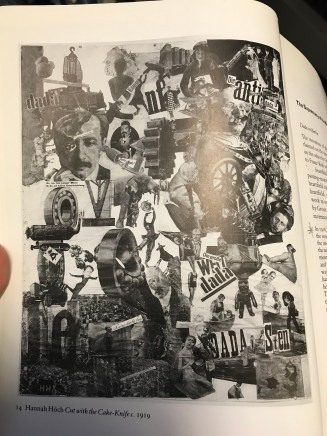
Hannah Höch, Cut with the Cake-Knife (c.1919).
Hannah Höch was a Dada artist, best known for her political collages and photomontages. Her compositions share a similarly dynamic and layered style to the works of her inspirations: Pablo Picasso and fellow Dada artist, Kurt Schwitters. Höch used her work to critique the failings of the Weimar German Government, by rearranging images and text from the mass media into collages. She preferred to be more metaphoric with her imagery, rather than taking a direct approach using text and confrontation, such as the work of John Heartfield. When the above piece was created, there was political chaos in Germany after the lost WWI. There was a struggle between two political parties; German society was navigating its way out of the old Weimer Republic and into the left-wing Communist movement. The artists within the Dada movement used photomontage to express messages of critique that would not be allowed to be put into words because of censorship. Pieces of machine can be seen exploding throughout the montage, symbolising the booming industry and culture within urban areas. This process is portrayed in a circus-like environment, rather than in a proud and sophisticated manner; the theatrical expressions and body language, mixed in with images of political figures, are used to critique the two political parties.
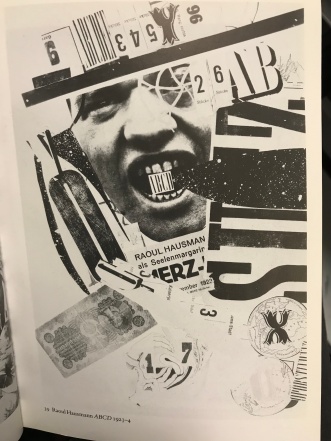
Raoul Hausmann, ABCD (1923-4).
Hausmann was an Austrian artist, best known for his satirical photomontages and his provocative writing on art. He was the founder and central figure of the Dada movement in Berlin. He met Hannah Höch in 1915 and they established a romantic affair and artistic partnership that lasted until 1922. He was involved in Expressionism until 1917, when he was introduced to the principles and philosophy of Dada; these artists created works that could question capitalism and conformity, as they believed this was the motivation for the war that had just ended, leaving behind chaos and destruction. Similar to Höch, Hausmann created collages by superimposing photos and text together that he found in newspapers, magazines, etc. In fact, it is believed that Hausmann and Höch discovered photomontage while they were on vacation on the Baltic Sea in 1918. ABCD was the final photomontage he produced, before he turned to more-traditional media. In the image, his face appears in the centre with the letters ABCD clenched in his teeth, in reference to a Dada poem. An announcement for one of his poetry performances is also collaged right below his chin. You can also see the word “voce” to the left side of his face; this translates to “voice” and represents the voice of the people wanting a revolution.
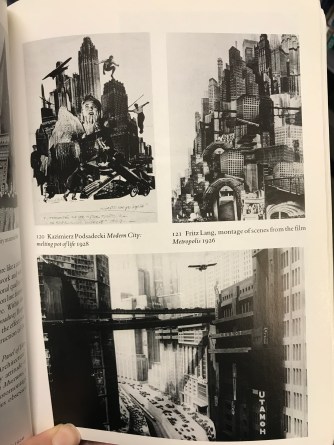
Top left: Kazimierz Podsadecki, Modern City: Melting Pot of Life (1928).
Podsadecki was a Polish painter and creator of Constructivist art. He was also interested in photomontage and experimental films. His early works were photos of compositions that he had made from various objects, and these may have been influenced by the concepts of Man Ray and Marcel Duchamp. He quoted important modernist photographs and films within his work, which was unique within European modernist art of the time. Modern City: Melting Pot of Life is themed around life in a metropolis and participation in a modern technical civilisation. It is an example of Catastrophism, which was a popular trend in the culture of the 1920s and 1930s; the trend mentioned not only the previously mentioned civilisational progress and technological development, but perhaps most importantly the subject of war, which was often depicted by an apocalyptic vision of the future. The image is dominated by solid modern tower blocks which are pieced together to create a compact mass, which represents the way that architecture is dominating and unstable and is overwhelming the world and its inhabitants.
As soon as I saw this image, it reminded me of the skyscrapers and tower blocks that I saw and photographed on the university trip to New York in February. This has given me the idea to create a constructed image, such as a collage, featuring some of these buildings somewhere. My initial thought is a teacup and saucer with the landmark buildings stood up inside, like a little city within the cup. I will work on this and experiment with layers and masks on Photoshop.
 PHOT40151 / THE PHOTOGRAPHER'S EYE, JADE WARD, SUPPORTING WORK